News.
Greenroom Robotics wins Australian Subsea Business Award for Innovation

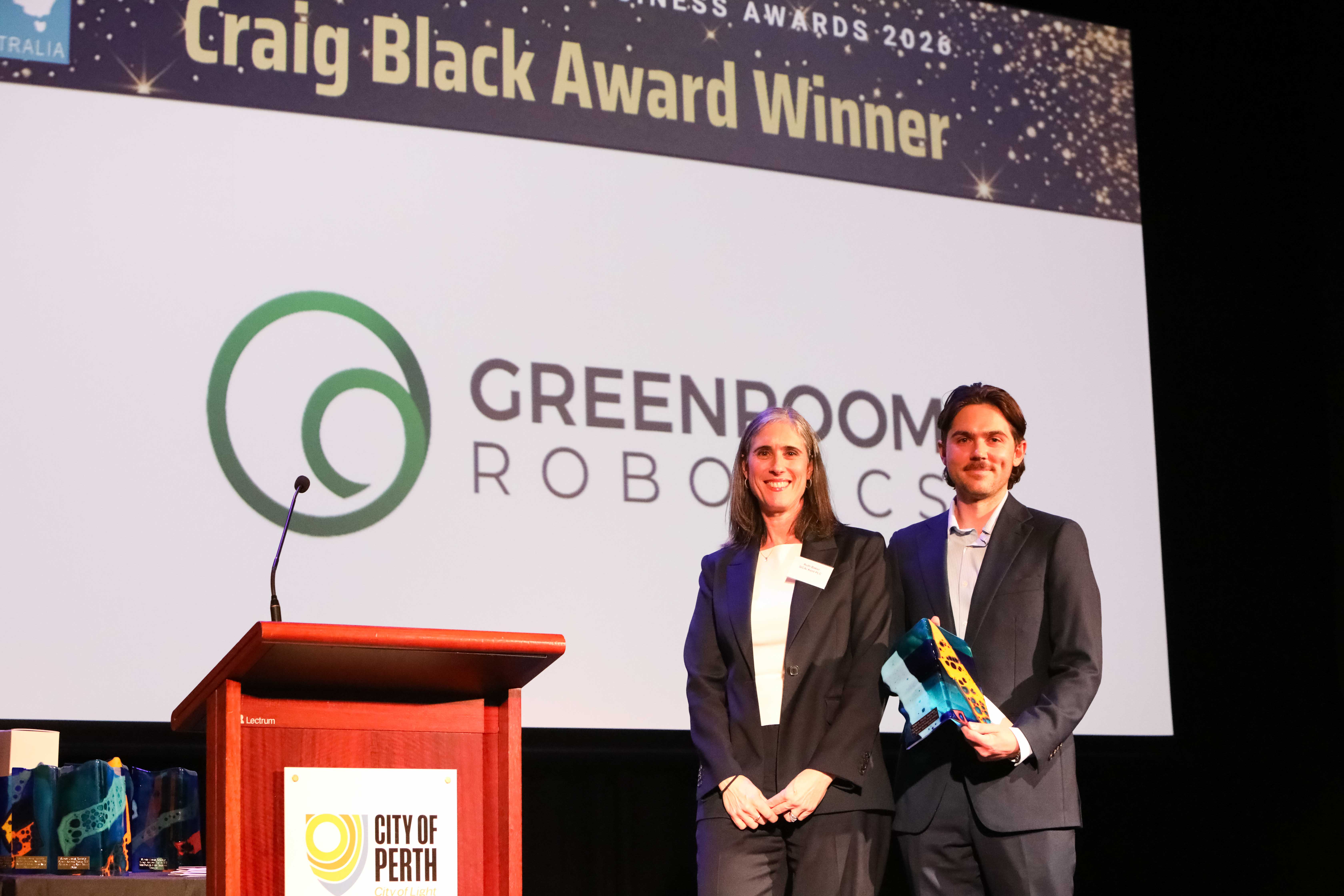
Greenroom Robotics is the proud winner of the Craig Black Award for Innovation and Technology at the 2026 Australian Subsea Business Awards. The Innovation Award recognises a product, service or technology that successfully entered the Australian subsea and ocean-based market in FY26, driving industry growth or opening new capability.
The winning technology is Dynamic Predictive Control (DP-C), part of GAMA, Greenroom Robotics maritime autonomy software. DP-C enables conventional workboats to perform precision station keeping and subsea tracking tasks that would normally require a dedicated DP-class vessel.
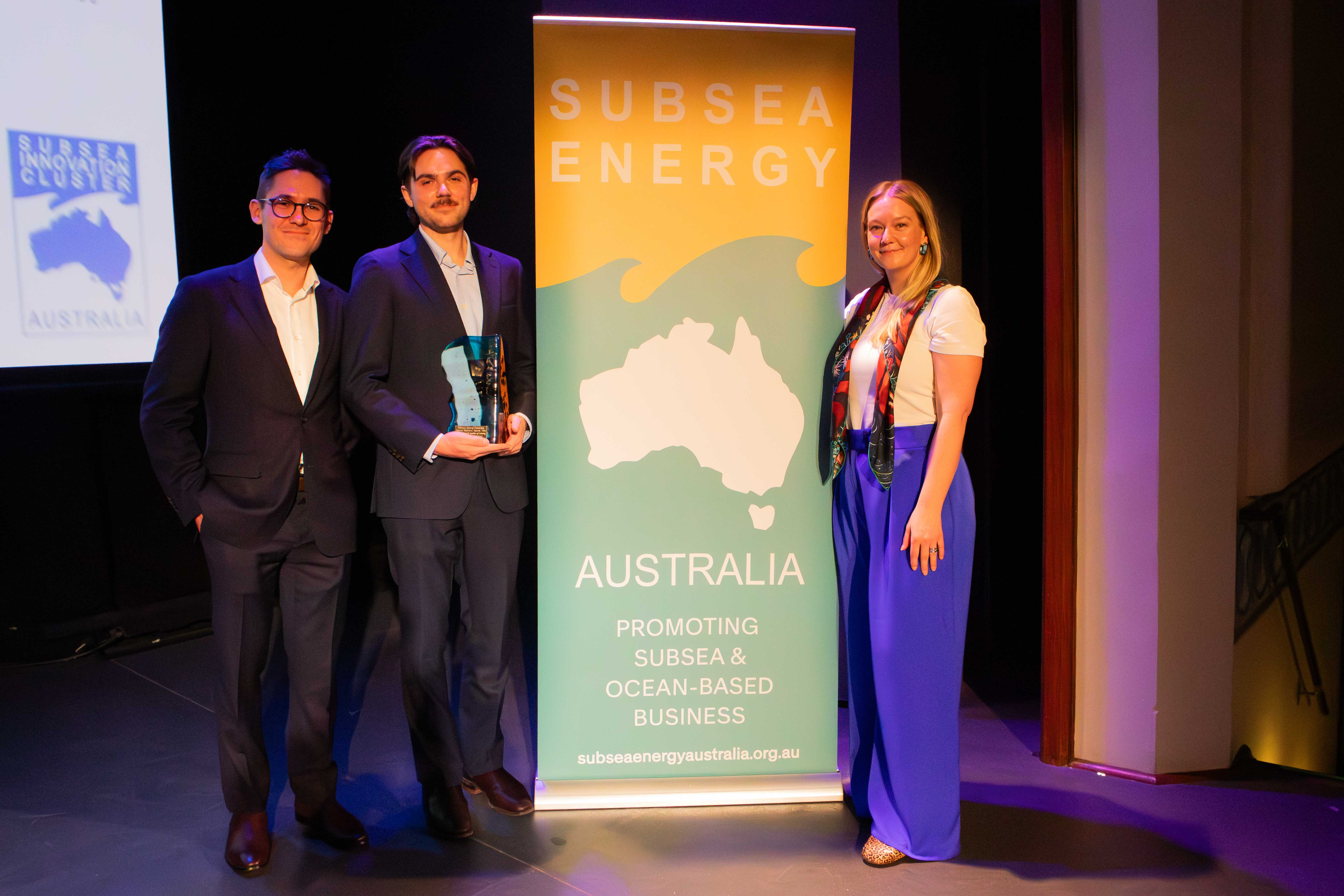
Greenroom Robotics team accepting the Craig Black Award for Innovation and Technology at the Australian Subsea Business Awards 2026.
The innovation behind the win
DP-C independently controls a vessel's thrusters, propellers and rudders using sensor feedback and control algorithms to counter wind, waves and current. Paired with an underwater positioning system, it gives GAMA the ability to track a moving ROV or AUV in real time and hold position with DP-equivalent precision.
Because DP-C is a retrofit to existing crewed workboats, operators don't need to invest in a new vessel to access this capability. The economics are significant. Workboat operators can bid for higher-value work, like ROV-follow tasks, that previously sat out of reach without a DP-class vessel. And for the companies chartering those vessels, it means access to dynamic, precision control at a day rate around 80% lower than a DP-class alternative, with lower risk than manual precision control.
Proven in the field aboard Tenggara Explorer
DP-C was commercially deployed on the 34-metre workboat Tenggara Explorer, integrated alongside Sonardyne's Mini-Ranger 2 USBL positioning system to enable precision ROV-follow for inspection-class ROVs. The integration involved direct interfacing with the vessel's helm, propulsion and auxiliary thrusters, combined with sensor fusion of GPS, IMU, wind and USBL data to maintain a stable lock on both fixed coordinates and moving underwater targets.
The result was improved vessel utilisation and addressable work scope for Tenggara Explorer, opening up ROV inspection and other precision tasks that would previously have needed a DP-class charter.
DP-C adoption has since expanded to EGS Survey, where it supports precision line-keeping, reducing cross-track error and improving subsea survey data quality.
Thanks to Sonardyne International Ltd, Unique Group and the Tenggara Explorer team, whose work integrating this capability into the Tenggara Explorer helped bring it to life in the field.
Why it matters for the sector
By retrofitting existing crewed workboats with precision control, DP-C opens new capability to workboat operators. It lowers the barrier to entry for high-value subsea work like pipeline inspection and offshore survey, creating new revenue opportunities for Australian workboat owners.
It also changes the job for the crews running these vessels. Rather than making constant manual thruster corrections, bridge teams can focus on project oversight, data quality and safety while DP-C manages fine vessel motion. This is upskilling crews in autonomy-assisted operations, not displacing them.
What's next
DP-C's software-based precision control is vessel-agnostic and already proven across ROV pipeline inspection, offshore survey line-keeping and defence station-keeping tasks. Because it retrofits to existing crewed, uncrewed or hybrid vessels rather than requiring new hardware, Greenroom sees a clear path to extend it into offshore energy, offshore wind turbine inspection and further defence support craft.
The next step is scaling from single-vessel deployments to fleet-level coordination, using DP-C to support multiple vessels coordinating station-keeping, target-following and survey tasks. Greenroom is also working to bring more of its AI perception directly into the control loop, enabling vision-informed, obstacle-aware positioning.
Further. Safer. Leaner.
The Craig Black Award recognises technology that has genuinely changed what's possible for Australian subsea operators in FY26. DP-C does that by making DP-level precision available to a much wider range of vessels, at a fraction of the cost.
Book a time to learn more about how GAMA's Dynamic Predictive Control could work for your fleet.